Friday, March 12, 2021

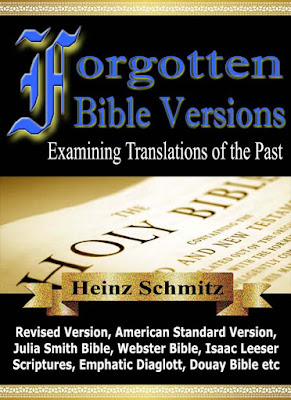
Divine Name Controversy & Mysteries - 50 PDF Books to Download (Tetragrammaton, Jehovah)

Only $5.00 -  You can pay using the Cash App by sending money to $HeinzSchmitz and send me an email at theoldcdbookshop@gmail.com with your email for the download. You can also pay using Facebook Pay in Messenger


Books Scanned from the Originals into PDF format


Books are in the public domain. I will take checks or money orders as well.

Contents:

Rare: The Holy Bible: Containing the Old and New Testaments by Julia E. Smith - 1876
Julia Smith's translation of the Bible stands out unique among all translations. It is the only one ever made by a woman, and the only one, it appears, ever made by man or woman without help. She also uses the Divine Name Jehovah quite liberally. (Genesis 1 is missing)

The Letter G, article in The American Tyler-keystone 1903 ("The swastika is composed of four gammas combined, and was known among old time craftsmen as the Tetragrammaton.")

An Interesting Question - How old is "Jehovah," article in Current Literature 1888

The Swastika in Atlantis, article in The Word 1915
 
National Religions and Universal Religions: Lectures Delivered at Oxford
by Abraham Kuenen 1882
"The Pronunciation of the Divine Name "Yahweh." By declaring, as soon as I had occasion to use it, that we have good grounds for pronouncing the name of the god of Israel "Yahweh," I implied that the objections which have been urged against this pronunciation—most recently by Friedrich Delitzsch (Wo Iag das Paradiesl Eine biblisch-assyriologische Studie, S. 158—166) and von Hartmann (Das relig. Bewusstsein u. s. w. S. 370 f.)—have not convinced me. I must now briefly explain the reason of this. On the derivation and significance of the name I will not now touch, but will confine myself exclusively to the anterior question of how it was pronounced." - Page 308

Divine Name Bibles on Youtube

How the Bible Grew: The Story as Told by the Book and Its Keepers
by Frank Grant Lewis 1919
"Where this divine name occurrs in the Hebrew, Israelitish readers pronounce the word for master, lord. This Hebrew word is ordinarily transliterated adonai. Israelites still say "Adonai" when in reading they come to the divine name. Christians, however, as early as the fourteenth or the fifteenth century began to combine the two words, pronouncing the consonants Jhvh with modifications of the vowels of adonai. We should expect perhaps as an outcome such a word as Jahovaih, but it did not come into use. Instead, one of the earliest results of the combination of the two words was the form Johouah. Later the form Jehovah was adopted. This is now known not only to be a hybrid term but also to have no good linguistic basis for its vowels. Careful investigations have been made concerning the original pronunciation of the divine name itself, that
is, investigations to discover the vowel sounds which were originally a part of the name. These investigations offer different possibilities, such as Jahveh, Jahvah, or even Yahu." - Page 84

Proceedings of the Society of Biblical Archaeology by Society of Biblical Archaeology 1895
With a chapter on: ON THE DIVINE NAME By REV. G. MARGOLIOUTH.

Jehovah the redeemer god: the scriptural interpretation of the divine name by Thomas Tyler - 1861

Light on the Old Testament from Babel by Albert Tobias Clay 1906
Page 247 discusses various pronunciations, such as Iabe, Yahwa, Yahwe and Yawa


A Misunderstood Jehovah by Heinz Schmitz

Ron Rhodes vs Jehovah - Jehovah, Yahweh or LORD? by Heinz Schmitz

My Response to Lynn Lundquist's "The Tetragrammaton and the Christian Greek Scriptures" by Heinz Schmitz

An Encyclopaedia of Freemasonry by Albert Mackey 1874

"Jehovah is, of all the significant words of Masonry, by far the most important."
The Symbolism of Freemasonry by Albert Mackey 1869

(has a chapter on the "Ineffable Name."
A 19th Century Witness to the Pronunciation of the Divine Name, article in JBL 1906

The Revealed Form of the Divine Name, article in the American Ecclesiastical Review 1899

The Tetra(?)grammaton, article in the Jewish Quarterly Review 1903

The Name Jehovah, article in The Oriental and Biblical Journal 1880

Dissertations on the genuineness of the Pentateuch by Ernst Wilhelm Hengstenberg

(Chapter: Origin of the Name Jehovah)
On the Hypothesis of the Egyptian or Indian Origin of the Name Jehovah by Prof. Tholuck, article in Biblical Repository and Classical review 1834'

The Theology of the Old Testament by G. Oehler - with a chapter on Age and Origin of the Name Jehovah 1874

The Pronunciation of the Divine Name "Yahweh." - the Hibbert Lectures 1882

Plato contra Atheos = Plato against the Atheists  1845 (with a chapter on The Philosophy of the Verb TO BE ("The epithet, therefore, must have had a higher significance, and seems to refer to this name Jehovah—The Being...")

Jehovah the Ripper, article in Flowers of Freethought Magazine 1894 -

"The Whitechapel murderer is shrouded in mystery. So is Jehovah. The Whitechapel murderer comes no one knows whence and goes no one knows whither. So does Jehovah. The Whitechapel murderer appears in different disguises. So does Jehovah. The Whitechapel murderer's movements baffle all vigilance. So do Jehovah's. The Whitechapel murderer comes and goes, appears and disappears, with the celerity and noiselessness of a ghost. So does Jehovah, who is a ghost."
Anacalypsis by Godfrey Higgins 1874 -

Voltaire, in his commentary on Exodus, tells us that some critics say the name Jehovah signifies destroyer. The Egyptians pronounced it Jaou, and when they entered into the temple of the Sun they carried a phylactery, on which the name laou was written. Sanchoniathon wrote it Jevo. Origen and Jerom think it ought to be pronounced Jao. The Samaritans called it Jave. From this name comes the ancient Jovis (ancient nom. case, see Parkhurst), Jo vispiter— Jupiter with the ancient Tuscans and Latins. The Greeks made from Jehovah their Zeus. The god Horus is stated by Dodwell to have the meaning of destroyer...
Studies in the History of Religions: Presented to Crawford Howell Toy by David Gordon Lyon, George Foot Moore 1912
"It has been contended that the name Yahweh as an element in a proper name occurs in Babylonia still earlier. In a text published by Thureau-Dangin, a granddaughter of the king Naram-Sin bears a name which may be read Lipush-Iaum, 'May Iaum make.' Radau, Burney, and Clay all regard this as an occurrence of Yahweh. Rogers with more caution holds that it is doubtful, and that possibly Ea is referred to. It would certainly be rash to assert that this name is proof that Yahweh as a divine name was known among the immediate descendants of Naram-Sin, but it is clearly possible that such may be the case.


Bible and Spade: Lectures Delivered Before Lake Forest College
by John Punnett Peters - Bible - 1922
"I was struck with the fact that the divine name Yah commences to become prominent in David's time. After he set up the Ark in Jerusalem, the divine name Yah becomes the dominating name in Judah, and especially in the royal family. On the other hand, it does not come to the fore among the ten tribes until two hundred years later, in the time of the great prophet Elijah, whose name means "Yah time the Pharaoh raided and plundered Palestine." p. 99

Theology of the Old Testament by Gustav Friedrich Oehler, George Edward Day 1883
With Sections: THE NAME JEHOVAH. Pronunciation and grammatical explanation of the
name
Signification of the name
Age and origin of the name Jehovah
Comparison of the name Jehovah with Elohim and El
Attributes or names of God which are derived immediately from the idea of Jehovah

Princeton Theological Review by Princeton Theological Seminary 1914 (partial copy)
"The Septuagint with one exception (18:1) attests the word Jehovah at the beginning of these paragraphs, as the first divine name in the seder, however much the Septuagint may differ from the Massoretic text in respect to the divine name elsewhere in the paragraph. Dahse's theory, it will be noted, accords with these facts regarding the initial divine name, and also accounts for the difference between the Massoretic text and the Septuagint in 18:1. And the general agreement of the two texts in regard to the divine name used, where a particular rule seems to have been followed by the author or early editor of the narratives, is an additional attestation of the fidelity of the Greek translators to their Hebrew text, and affords valuable testimony to the readings of the early Hebrew text."

Hours with the Bible: Or, The Scriptures in the Light of Modern Discovery
by John Cunningham Geikie - 1889
"Among the Egyptians there was a god whose name it was unlawful to utter; and it was forbidden to name or to speak of the supreme guardian divinity of Rome.' Even to mention a god's name in taking an oath was deemed irreverent. In the Book of Henoch 7 a secret magic power is ascribed to the Divine Name, and "it upholds all things which are." Men learned it through the craft of the evil angel, Kesbeel, who, in heaven, before he was cast out, gained it by craft from Michael, its original guardian." Page 839

The Pythagorean Triangle: Or, The Science of Numbers by George Oliver 1875
"...making together twenty-six, the same number as the Tetragrammaton. Reason apparently supports the idea that profound mysteries are contained in the characters of this holy language; and who will contend that they do not all involve many secrets and reasons for being used in the law of God, from the perfect art with which they are formed" p. 23

The great Dionysiak myth by Robert Brown 1877
"Clemens Alexandrinus says, 'the mystic name of four letters, 'the sacred Tetragrammaton YaHVeH, 'which was affixed to those alone to whom the adytum was accessible, is called Iaou, which is interpreted, "Who is and shall be." Mr. King observes, 'Theodoret states that the four letters of the Holy Name were pronounced by the Samaritans IABE; by the Jews, IAO Jerome (Ps. viii.), "The name of the Lord amongst the Hebrews is of four letters, Jod, He, Vau, He ; which is properly the name of God, and may be read as I A H O, and is held by the Jews for ineffable." ' 2Bunsen, very
reasonably, considers it questionable whether the real etymology of the word is Hebrew, but remarks, 'The sublime idea, "I am that I am," i.e. the Eternal, is certainly the right one in a Hebrew point of view.'"

Medical Symbolism in Connection with Historical Studies in the Arts by Thomas S. Sozinskey 1891
"Tetragrammaton — that is, J H V H, or, as it is commonly rendered, Jehovah — was the same thing as the IAW. Much could be said about it, as those familiar with Masonic legends and occult literature are aware. Lenormant states, of the wide belief in the power of the hidden "name of the Lord," that "we now see clearly that it came from Chaldea." p. 133

The Names of God in Holy Scripture: A Revelation of His Nature by Andrew John Jukes 1889

Cumorah Revisited: Or, "The Book of Mormon" and the Claims of the Mormons by Charles Augustus Shook 1910
"Latter-day Saints tell us further that the Indians were in the habit of using the sacred ejaculation, "Hallelujah," and Jenkins says: "In the Choctaw nation they often sing 'Halleluyah,' intermixed with their lamentations." — The Ten Tribes, p. 132. Elsewhere (p. 144) he informs us that both the Choctaw and Cherokee tribes use the word. The Creeks had a sacred chant, hi-yo-yu or hay-ay-al-gi* The Cherokees employed the sacred, but meaningless, chant, ha-wi-ye-e-hi, in their "Groundhog Dance;" he-e! hay-u-ya han-iwa, etc., was employed by their bear-hunters to attract the bear ; while ha-wi-ye-hy-u-we was a part of one of their baby songs. Hayuya falling on the ears of an Englishman might be mistaken for "hallelujah." Lastly, the words for "Jehovah" (Yohewah in the Cherokee, Che-ho-wa in the Choctaw, and Chihufa in the Creek) are not original words at all, and the same may be said for Shiloh, Canaan and other Old Testament names, but are simply the efforts of these tribes to pronounce our Scriptural terms."

View of the Hebrews: Exhibiting the Destruction of Jerusalem by Ethan Smith 1823
"These Indians have many wild pagan notions of this one God. But they have brought down by tradition, it seems, the above essentially correct view of him, in opposition to the polytheistical world. Their name of God is remarkable — Wahconda. It has been shown in the body of this work, that various of the Indians call God Yohewah, Ale, Yah, and Wah, doubtless from the Hebrew names Jehovah, Ale, and Jah, And it has been shown that these syllables which compose the mime of God,
sire compounded in many Indian words, or form the roots from which they are formed."

The Glorious Name of God, The Lord of Hosts: Opened in Two Sermons by Jeremiah Burroughs 1643 (very old copy, often hard to read, but beautiful to behold just the same)

Indian Myths Or, Legends, Traditions, and Symbols of the Aborigines
by Ellen Russell Emerson 1884
"the form Jehovah, instead of Yahweh or Yahaveh, has been adopted; but it may be justly claimed that the two latter words are the more accurate. In these we trace a still more remarkable resemblance to the sacred name of Indian invocation. An instance is quoted by M. Remusut from one of the works of a Chinese philosopher of the sixth or seventh century before Christ, in which the name appears in Chinese scriptures. The reference is as follows...Here again reappears the name as J-hi-wai, which, with due regard to phonetic and vernacular changes, may be claimed as identical with that of the Indian's sacred name, Yo-he-wah. The universality of the use of the syllable yo, or jo, in a divine name may be illustrated by other examples. lio was the Coptic name of the moon ; Java, or Kara-Java, was a name said to be given the Supreme Being by a tribe in the jungles of Burmah.
Page 638

A Discourse on the Religion of the Indian Tribes of North America: Delivered by Samuel Farmar Jarvis 1820 (only first 119 pages)
"Much stress has been laid upon the supposed use of the Hebrew words Jehovah and Halliluiah among the Indians. With regard to the invocation of God, by the name of Jehovah, the fact, in the first place, is not certain. Some travellers assert that the Indians, when assembled in council, and on other solemn occasions, express their approbation by ejaculating Ho, ho, ho, with a very guttural emission. In the minutes of a treaty, held at Lancaster, I think in 1742, on which occasion Conrad Weiser was interpreter, it is said that the chiefs expressed their approbation in the usual manner, by saying, "Yo-wah." p. 90

Light and Truth: Collected from the Bible and Ancient and Modern History by Robert Benjamin Lewis 1844
"In their sacred dances, these authors assure us the Indians sing "Halleluyah Yohewah;"—praise to Jah Jehovah. When they return victorious from their wars, they sing, Yo-he-wah; having been by tradition taught to ascribe the praise to God. The same authors assure us, the Indians make great use of the initials of the mysterious name of God, like the tetragrammation of the ancient Hebrews; or the four radical letters which form the name of Jehovah; as the Indians pronounce thus, Y-O-He-wah." p. 261

The Cabala, its influence on Judaism and Christianity by Bernhard Pick 1913 (the Tetragrammaton features prominently in the Kabbalah)

Holy Holy Holy - A Study of the Trisagion 1913 (features the Tetragrammaton)

The Words of Jesus considered in the light of post-Biblical Jewish writings by Gustaf Dalman (did Jesus use the Divine Name? p.182) 1902

The Natural Genesis by Gerald Massey (has a section on the Typology of the Mythical Trinity which talks about the Tetragrammaton) 1883

The Secret Tradition in Freemasonry by Arthur Edward Waite Volume 1, 1911 ("But Tetragrammaton was reserved and incommunicable in respect of another hypothesis, because it expresses eternity and the nature of the Divine Essence; it is referred to in this sense in the Book of Wisdom. According to the Talmud, both natural and eternal death were visited on those who dared to utter the sacred word in public, metaphorically because the effect was to subvert heaven and earth.")

The Secret Tradition in Freemasonry by Arthur Edward Waite Volume 2, 1911


Join my Facebook Group

Thursday, March 11, 2021

Early Opinions About the Holy Ghost, by Joseph Priestley


This book, "The Impersonality of the Holy Spirit by John Marsom" is available on Amazon for only 99 cents.

See a local listing for it here

EARLY OPINIONS ABOUT THE HOLY GHOST

From: A History of the Corruptions of Christianity By Joseph Priestley, 1871 edition, pp. 326, 327

IT is remarkable, that, notwithstanding the doctrine concerning the person of Christ had been the great subject of controversy ever since the promulgation of Christianity, there is no mention made of any difference of opinion concerning the Holy Spirit, that attracted any notice, till after the commencement of the Arian controversy, and even till after the Council of Nice.

Justin Martyr, to whom we are indebted for the first rudiments of the doctrine of the divinity of Christ, says but little concerning the Holy Spirit; and from that little it is not easy to conclude what his real opinion was. But it is probable that he considered the Spirit as a created being, since he represents him as inferior to Christ.

Ireneaus seems to have considered the Holy Spirit as a divine influence, and no proper person. "By the name of Christ," he says, "we are given to understand one who anoints, one who is anointed, and the unction with which he is anointed. It is the Father who anoints, but the Son is anointed in the Spirit."

Valentinus thought the Holy Spirit to be of the same rank with the angels.

Origen considered it as doubtful whether, since all things are made by Christ, the Holy Spirit was not made by him. And after discussing the question a little, he says, "We who maintain three hypostases, the Father, Sen, and Spirit, and believe that the Father only is unbegotten, think it more agreeable to piety and truth, to maintain that the Holy Spirit is superior to all things that were made by Christ."

Tertullian seems to have thought that the Holy Spirit was derived from Christ, in the same manner as Christ was derived from God.

Novatian, who had as much orthodoxy with respect to the Trinity as any person of his age, certainly did not believe in the divinity of the Holy Spirit, whom he represents as inferior to the Son, whom also he makes greatly inferior to the Father. "Christ," says he, "is greater than the'Paraclete; for he would not receive of'Christ if he was not less than he."

Athenagoras considered the Holy Spirit as an efflux from the Deity, flowing out and drawn into him again at pleasure, as a beam from the sun.

Eusebius, who appears to have been, as orthodox as other writers of his age with respect to the Son, (if his writings may be allowed to testify for him), and who certainly was not bold in heresy, scrupled not to consider the Spirit as made by the Son. "The Holy Spirit," says he, "is neither God nor the Son, because he did not derive his birth from the Father, like the Son, but in one of the things that was made by the Son; because all things were made by him, and without him was nothing made."

Even Hilary, who wrote so largely concerning the divinity of the Son, seems not to have had the same persuasion concerning that of the Holy Spirit; but, in the little that he says on the subject, seems rather to have considered the Spirit as a divine influence.

The reasoning of the fathers concerning the divinity of the Holy Spirit lies in a much smaller compass than that concerning the divinity of the Son. One principal reason of this is, that so little mention is made of the Holy Spirit in the Scriptures, and still less that can possibly be construed into an evidence of his being a divine person. This is a circumstance that could not escape notice, and which required to be accounted for by the orthodox

Among others, Epiphanius has advanced a reason which is curious enough. It goes upon the idea of the Holy Spirit being that person of the three which immediately dictated the Scriptures. He says, that "the Holy Spirit says little concerning himself, that he might not commend himself, the Scriptures being written to give us examples."

It was Athanasius, the great advocate for the divinity of Christ, and his consubstantiality with the Father, who also exerted himself strenuously and effectually in behalf of that of the Holy Spirit, whose divinity was denied by Macedonius. He informs us, that he was in the deserts of Egypt when he heard of that heresy, and that he wrote from thence to prevent the spread of it. He had so much influence in, Egypt, that a Synod was immediately called there, which he attended, and where the Holy Spirit was for the first time decreed to be consubstantial with the Father and the Son.

Not long after this, the divinity of the Holy Spirit was more solemnly determined at a council held in Constantinople, and from that time it was deemed equally heretical to deny the divinity of the Spirit as that of the Son.


Sunday, February 28, 2021

Romans 9:5 and the Deity of Christ


Buy on Amazon for only 99 cents by clicking here - see a local listing for this here

From: The “Proper Deity of the Word” 1834 (Page 22) by John Scott Porter

Let us now consider...Romans 9:5,-“Of whom, as concerning the flesh Christ came, who is over all, God blessed for ever.” I have no reluctance, whatever, to let this verse stand as it is, without the slightest alteration or amendment of the common translation, although the words will readily admit of a different rendering; and, still, I maintain, that it does not carry out the proof of our Lord's Proper Deity.

[The Rev. Mr. Bagot, in the printed Abstract of his Sermons, has favoured his readers with five different methods of eluding the force of this passage, proposed by anti-Trinitarians. This was very kind in him; and, of course, the Unitarians are most grateful. At the same time, his kindness was thrown away, as the force which he ascribes to the passages, can be eluded, with equal ease, even if we admit the common reading. If Dr. DRUMMOND chose to suggest a transposition and alteration of the original text, Dr. DRUMMOND is, alone, responsible. The Unitarian body are no more accountable for Dr. DRUMMOND's criticisms, than the Episcopalians of Ireland are for Mr. Bagot's.]

We have, already, seen with what latitude the epithet “God," is used in Scripture. We have seen it applied both to men and angels. Our Saviour, himself, assures us, that the title was bestowed upon all “to whom the Word of God came.” How very applicable, therefore, would it be to Him to whom “the Father bath given the Heathen for an inheritance, and the uttermost bounds of the earth for a possession?” How very applicable would the title be to Him, “who must reign, till he hath put all enemies under his feet:” till Death himself be destroyed: till, having no more enemies to curb, he shall deliver up the kingdom to God, even the Father; and “himself be subject unto Him, who put all things under Him, that God may be all in all.” And here, too, as on every other disputed point, we are anxious, that the quotation may not be read separately from the context; for the verses preceding it abundantly prove, that the Apostle had no idea, whatever, of ascribing Proper Deity to the person whose doctrine he was recommending to the Jews. The context will not justify us in awarding the title God, to our Saviour, in any other sense than as subordinate to the Father.

But, it was not necessary, for our argument, to have shown the insufficiency of this alleged proof. The Rev. Gentleman, at the commencement of his discourse, discarded the term Christ as an improper phrase; because, as he asserted, Christ was the name of a complex Being, and expressive of Proper Manhood, not less than of Deity. But, here, the Apostle uses no other name than Christ. He even traces his descent from the Father's, according to the Flesh. And, it is with reference to the FLESH, that he calls him “God over all, blessed for ever.” The Rev. Gentleman was, therefore, bound by his own rules not to have advanced this text: but even if it had established his point, it would have proven, not the Proper Deity of the WORD, but the Proper Deity of the Man.
Let him, however, avail himself of it, if he will, and apply it to our Lord; and he cannot, by any power of argument, deduce from it unequivocal proof of his Proper Deity.

xxxxxxxxxxxxxxxxxxxxxxxx

See also On the Construction of Romans 9:5 by Ezra Abbot 1881
"...Christ, who is God over all, forever praised. Amen." New International Version

Now compare:

"God who is over all be forever praised." NIV footnote
"...God, who is over all, [be] blessed forever. Amen." NWT
"May God, supreme above all, be blessed for ever! Amen" New English Bible
"God, who is over all be blessed for ever." Revised Standard Version
"Blessed for evermore be the God who is over all!" Moffatt
"May God, who rules over all, be praised forever!" Good News Bible/TEV
"God who is over all be blessed forever." Smith&Goodspeed's An American Translation
"May God, supreme above all, be blessed for ever! Amen" Revised English Bible
"I pray that God, who rules over all, will be praised forever!" Contemporary English Version
"He who is over all, God, blessed unto the ages." Rotherham's Emphasized Bible
"God is over everyone, Praise Him forever." Simple English Bible
"God be blessed who is above all things forever." Unvarnished NT/Andy Gaus
"God who is over all be blessed forever." New American Bible*
"God is over everyone, Praise Him forever." International English Bible
"May God, who reigns over all, be blessed through the ages." Pre-Nicene New Testament
"God be exalted throughout the Eons." Eonian Life Bible New Testament
"May God who is over all, be blessed forever." Wilton Translation New Testament

"Does Paul speak of Jesus as 'God/god'? The debate here revolves round one text in particular - Rom. 9.5...the juxtaposition of 'the Messiah' and 'he who is over all, God' would most obviously suggest different referents, rather than the same person in different status...to infer that Paul intended Rom. 9.5 as a benediction to Christ as 'God' would imply that he had abandoned the reserve which is such a mark of his talk of the exalted Christ elsewhere. And this would be no insignificant matter. For it would not allow any of the qualification outlined above in terms of God sharing his sovereignty with the exalted Christ. For 'he who is over all, God' can hardly be other than the one God, the Creator, elsewhere described by Paul (in his benedictions!) as 'the God and Father of'our Lord Jesus Christ.'" The Theology of Paul the Apostle by James D. G. Dunn

"Paul’s clear statements elsewhere, such as 1 Corinthians 8.6 and Ephesians 4.5-6, on the same subject should indicate his intent in Romans 9.5b. Plus, his constant practices of affirming strict monotheism, distinguishing Christ and God, subordinating Christ to God, and identifying only the Father as God indicate he could not have intended to call Christ “God” in Romans 9.5b." Kermit Zarley

"Rom. 9.5 is disputed. After Paul has expounded the position of Israel in salvation history and has emphasized as an especial advantage the fact that Christ according to the flesh, stems from this people, he adds a relative clause, which runs lit. “who is over all God blessed for ever. Amen.” Even so, Christ would not be equated absolutely with God, but only described as a being of divine nature, for the word theos has no article. But this ascription of majesty does not occur anywhere else in Paul. The much more probable explanation is that the statement is a doxology directed to God, stemming from Jewish tradition and adopted by Paul. Overwhelmed by God’s dealings with Israel, Paul concludes with an ascription of praise to God. The translation would then read, 'The one who is God over all be blessed for ever. Amen.” or alternatively, “God who is over all be blessed for ever. Amen.'" J. Schneider, “God” in The New International Dictionary of New Testament Theology, vol. 2, ed. Colin Brown, (Grand Rapids: Zondervan, 1976), p. 80.

Sunday, February 21, 2021

John 1:1, Exodus 7:1 and the Indefinite Article


From Rammohun Roy (Raja) "Works on Christianity" 1901 (Page 43)

They...render the last sentence of the verse “the word was God," without the indefinite article “a” before “God,” while they translate Exod. 7:I, "I have made thee (Moses) a God to Pharoah," though, in the original Hebrew, there stands only the word Elohim or "God," without the indefinite article “a” before it. If regard for the divine unity induced them to add the article "a" in the verse of Exodus, a God to Pharoah,” why did not the same regard, as well as a desire of consistency, suggest to them to add the article “a” in John 1:1, “the word was a God”? We may, however, easily account for this inconsistency. The term “God” in Exodus is applied to Moses, the notion of whose deity they abhor; but as they meant to refer the same term in John 1:1, to Jesus, (whose deity they are induced by their education to support) they leave the word “God” here without the article “a,” and carefully write it with a capital G. Lastly. If eternity be understood by the phrase "In the beginning," in John 1:1, and Jesus Christ be literally understood by the “word," then we shall not only be compelled to receive Christ as an eternal being, but also his apostles; since Luke (ch. 1:2) speaks of himself and his fellow disciples, as "eye-witnesses and ministers of the word from the beginning.”

This book, "The Impersonality of the Holy Spirit by John Marsom" is available on Amazon for only 99 cents. See a local listing for it here; Buy The Absurdity of the Trinity on Amazon for only 99 cents by clicking here - see a local listing for this here


John 1:1 a Unitarian Text


From: The “Proper Deity of the Word” 1834 (Page 19) by John Scott Porter

"In the beginning was the Word, and the Word was with God, and the Word was God." This is a text on which our Trinitarian brethren rely with peculiar confidence. Yet, in my mind, it does not clearly establish their point. And, if it does not do this, clearly and unequivocally; if, after having carefully examined it, a doubt exists in the mind, NOT PROVEN must be the verdict of any upright judge. Let us examine the text. It asserts that “the Word was God.". Now, I admit, that our Saviour is here designated as “the Word;" and the Word, God. In short, I admit that our Saviour is here styled God; but I deny, that the Evangelist, in giving him this title, could possibly have meant to lay down the doctrine of his Proper Deity. For, look to the language he employs. He says, indeed, that the Word was God, but, when he also says, the Word was with God, does he not clearly show, that he speaks of Christ in an inferior sense? If our Saviour was Proper Deity, how could John say of him, he was with God? that he was with himself? Would not this be perfect nonsense? If, then, it would be absurd to say that God was with himself, does it not follow, that he must have been with a separate and distinct Being; and, if we admit this separate and distinct Being to be infinite, does it not follow, that there were, in the beginning, two infinite Beings, dwelling together; or, in other words, that there were more Gods than one? This never could have been the Evangelist's meaning. The interpretation of our Trinitarian brethren goes too far, even for themselves. It would justify Polytheism.

Surely those who teach the Proper Deity of our Lord, and try to prove it by the text under consideration, are bound, if not in equity, at least in charity, to tell us, clearly, what their meaning is, when they use the words, and furnish the world with an intelligible paraphrase of this important passage.

We think that our interpretation of the introduction of John, is the only one that is intelligible to the reader, consistent with the general tenor of Scripture, or honourable to the Supreme Being. We say that Christ was with God,” by the close affinity which subsisted between Him and the Father. He had no feeling, no purpose at variance with his will. In this sense, he was one with him.

Again, our Saviour might be called God, in perfect consistency with Hebrew usage, and Hebrew phraseology. If those to whom the Word of God came, are called Gods, in Scripture, well might He receive the same title, “who was the brightness of the Father's glory, and the express image of his person;" “and in whom, was the fulness of the Godhead bodily.” That this interpretation of John, 1:1, is as Scriptural, as it is simple and intelligible, may be seen by consulting many portions of holy writ. See Genesis, 3:5,“In the day, that ye eat thereof, ye shall be as Gods,” i. e., as angels. See also, Judges, 13:22,-"Then Manoah said unto his wife, we shall surely die, because we have seen God.” Here, the epithet God is applied without any circumlocution to one, who was evidently nothing more than God's messenger. Again, this title is applied to mere men; as Exodus, 7:1,-"See I have made thee a God to Pharaoh, &c." And, again, Ist Samuel, 28:13,-“And the woman said unto Saul, I saw Gods ascending out of the earth: and he said unto her, what form is he of? And she said unto him, an old man cometh up, and he is covered with a mantle. This passage is interesting in more ways than one; it not only illustrates the Hebrew custom of applying the epithet God, to a mere mortal; but it also proves, that this people often made a plural noun, to express a singular meaning. The woman said, she saw Gods ascending out of the earth, and the monarch asked, what form is HE of not, what form are THEY of, as would have been said, had plurality of persons been implied by the woman, or understood by the King.

It would be tiresome to recount all the passages in which the title God is ascribed to persons vastly beneath that rank which every Unitarian awards his Saviour. Suffice it to state, that the title is ascribed to the Judges of Israel; to other eminent men; to angels, and even to false deities. O, but our opponents answer, “Although we admit the truth of what you affirm, we hold, that in all the places where such titles are given, the rank of the individuals can be easily learned from the collateral passages.” This is, undoubtedly, true. The inferiority of such beings, to God, may be easily learned by such a comparison. And, by the same steps we affirm, may our Lord's inferiority to the Father be ascertained. As a proof of this, look to the 14th verse of the chapter before us. We there read, “that the 'Word' was made flesh, and dwelt among us; and we beheld his glory; the glory, as of the only begotten of the Father, full of grace and truth.” Here (then) the passage explains itself. Here it demonstrates, in the most unequivocal manner, the inferiority of our blessed Lord to the Father. "The Word became flesh," not

the Father. God could not become flesh, for he is a Spirit. He might, indeed, (as the orthodox hold) unite himself with flesh and blood; and, if it were so stated in Scripture, we could not argue against the doctrine. But the Evangelist does not even say that the Divine Word attached itself to the man Christ, so as to exhibit, at once, two perfect natures. There is no such union even hinted at. “The Word, itself,” he affirms, “became flesh, and dwelt amongst us, and we beheld his glory.” What glory? The glory as of the ONLY BEGOTTEN Son of God.” If this be not broad, plain, on equivocal, downright Unitarianism, language has no meaning.


Sunday, February 7, 2021

A Non-Conservative Look at Liberal Bible Translations


I came across this entry at https://www.conservapedia.com/Liberal_Bible_Translations on Liberal Bible Translations, which I found rather amusing. 

It starts out by saying: "Liberal bible translations are attempts to distort Biblical text to support liberal ideals." 

In fact, it has been my experience that Evangelical bible translations are attempts to distort Biblical text to support Evangelical ideals.

The examples it gives of Liberal Bibles are: 
Today's New International Version
Amplified Bible
Jerusalem Bible
New Jerusalem Bible
Moffatt Bible
Goodspeed Bible
Revised Standard Version
Revised English Bible
New American Bible

First, let's discard the TNIV and the Amplified Bible, which no one their right mind believes are Liberal Bibles. This leaves us with:


The problems with these Bibles, as indicated on the site, are:

"Political correctness towards gender by using "gender inclusive" language
Downplaying the existence of Hell and God's judgment
Downplaying the deity of Jesus
Downplaying the power of the Holy Spirit
Denying the prophecy of the virgin birth of Jesus
Downplaying the prohibition on homosexuality
Downplaying the differences between men and women
Editorializing on passages to push a liberal point of view
Adding content"

Of the above Bibles, only the New Jerusalem Bible and the New American Bible can be accused of using "gender inclusive" language. While I myself may prefer the traditional use of "man", when I check out even older works like Vine's Dictionary, Strong's Dictionary and Thayer's Lexicon, they give "human being" as the primary definition of anthropos (see also BAGD and BDAG)

As for "Downplaying the existence of Hell and God's judgment" I notice that the Revised Standard Version uses the word "hell" 14 times, as does the New Jerusalem Bible. In fact, near as I can tell, of the above list of Bibles, only the Catholic New American Bible refrains from using the word Hell. No Bible should use the word Hell. Hell is translated from the words Sheol, Hades, Gehenna and Tartarus. A good Bible should translate with those words, instead of adding a word that has no right to be there. 

Downplaying the deity of Jesus: Rudolf Bultmann’s wrote that "In describing Christ as _God_ the New Testament still exercises great restraint." Also, "There is scarcely one text alleged by the Trinitarians which is not otherwise expounded by their own writers".—John Locke (Common Place Book)

"When we consider further the fact...that Christ is nowhere called God in any unambiguous passage by any writer of the New Testament and that it is nowhere recorded that he ever claimed this title, we cannot reasonably regard this abstinence from the use of the term as accidental." Ezra Abbot

The Bible downplays the deity of Jesus, not Liberal Bible Translations.

As for "Downplaying the power of the Holy Spirit" I wish I had some examples to go on.

Moving on to "Denying the prophecy of the virgin birth of Jesus" I have to assume this means Isaiah 7:14. The King James Version here uses the word "virgin" while the above "Liberal" Bibles use the words "young woman." [The Jerusalem Bible actually uses "maiden" and some editions of the New American Bible use the word "virgin." See above image.] However, while even I prefer the word "virgin" here, most of my lexicons give "young woman" as the primary definition of the Hebrew word Almah.

As for "Downplaying the prohibition on homosexuality" I went straight to 1 Corinthians 6:9 to see what words the above Bibles used. While the King James Bible uses the watered-down term "effeminate", the RSV and REB uses "sexual perverts" [the REB's predecessor, the New English Bible used "homosexual perversion"], the JB & NJB and Moffatt uses "sodomites", Goodspeed uses "given to unnatural vice" while the NAB uses "practicing homosexuals." It doesn't sound like they downplayed anything in this regard. 

As for the rest, like "Downplaying the differences between men and women" seems to me to be part of the first complaint, "Political correctness towards gender by using "gender inclusive" language."
Editorializing on passages to push a liberal point of view, and Adding content is too vague to comment on, especially since Evangelical Bibles can also be accused of the same.

As we can see, supposed Liberal Bibles hold up well to the complaints brought against them, and can complement any Bible library. Also, it is not lost on me that many of the Bibles on their list are Catholic Bibles (there are popular Catholic editions of the RSV as well). Protestant and Evangelicals claim to derive their beliefs from the Bible, so they add their beliefs into the text of their Bible translations. Catholics on the other hand don't derive their beliefs from the Bible. As Robert M. Price stated in the review of Jason Beduhn's book: "Catholics can be freer with the details of the text because they don’t have to pretend to find their theology in it in full-blown form." http://www.robertmprice.mindvendor.com/reviews/beduhn_truth.htm 


metatron3@gmail.com

Thursday, February 4, 2021

The Codex Sinaiticus on This Day in History


This Day in History: The Codex Sinaiticus was discovered in Egypt on this day in 1859. This Codex is the oldest major manuscript of the New Testament, with sections of the Old Testament as well. This was a major find in the area of Textual Criticism. Alongside the Codex Alexandrinus and Codex Vaticanus, these three set the ground for newer translations of the Bible with a move away from the later Greek text (Textus Receptus) of the King James Bible. 

Constantin von Tischendorf found them in a monastery in Egypt with an interesting story. He wrote that during his first visit to the Saint Catherine's Monastery, he saw some leaves of parchment in a waste-basket. They were "rubbish which was to be destroyed by burning it in the ovens of the monastery", although this is firmly denied by the Monastery. After examination he realized that they were part of the Septuagint (Greek Old Testament), written in an early Greek uncial script. He retrieved from the basket 129 leaves in Greek which he identified as coming from a manuscript of the Septuagint. He asked if he might keep them, but at this point the attitude of the monks changed. They realized how valuable these old leaves were, and Tischendorf was permitted to take only one-third of the whole, i.e. 43 leaves. 

"If you were to name one of the most important books in the world, your first choice isn’t likely to be the Codex Sinaiticus. But if you did, you’d be correct!...Handwritten in the fourth century, it also contains the oldest complete copy of the New Testament." Source