Friday, December 1, 2023

Bible Scholar N.T. Wright on This Day in History


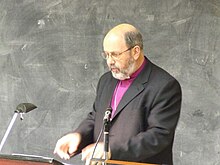
This day in history: Nicholas Thomas Wright FRSE was born on this day in 1948. N. T. Wright (or Tom Wright) is an English New Testament scholar, Pauline theologian and Anglican bishop. He was the bishop of Durham from 2003 to 2010. He then became research professor of New Testament and Early Christianity at St Mary's College in the University of St Andrews in Scotland until 2019, when he became a senior research fellow at Wycliffe Hall at the University of Oxford.

If you're a Bible collector like myself, then you know N.T. Wright for his criticism of the New International Version Bible. He wrote:

"In this context, I must register one strong protest against one particular translation. When the New International Version was published in 1980, I was one of those who hailed it with delight. I believed its own claim about itself, that it was determined to translate exactly what was there, and inject no extra paraphrasing or interpretative glosses. This contrasted so strongly with the then popular New English Bible, and promised such an advance over the then rather dated Revised Standard Version, that I recommended it to students and members of the congregation I was then serving. Disillusionment set in over the next two years, as I lectured verse by verse through several of Paul's letters, not least Galatians and Romans. Again and again, with the Greek text in front of me and the NIV beside it, I discovered that the translators had another principle, considerably higher than the stated one: to make sure that Paul should say what the broadly Protestant and evangelical tradition said he said. I do not know what version of scripture they use at Dr Piper's church. But I do know that if a church only, or mainly, relies on the NIV it will, quite simply, never understand what Paul was talking about." Wright, N. T. (2009). Justification : God's Plan and Paul's Vision. Downers Grove, Illinois: IVP Academic. pp. 51–52. ISBN 978-0-8308-3863-9.

This criticism is echoed by many others.

James Barr, in Modern English Bible Versions as a Problem for the Church_ Quarterly  Review/Fall 1994 writes:

"But this was not the end of the story. If on the one hand the conservative acceptance of the RSV as usable betokened a certain willingness to work along with the main currents of Christendom, there still existed the impulse to evangelical separatism, the unwillingness to do anything or accept anything that was not totally and purely "evangelical." The most important manifestation of this latter tendency is the so-called NIV, or New International Version, (New Testament, 1973; whole Bible, 1978).
The preface to this version begins with one of the most whopping falsehoods ever to be written into a Bible version by a group of 'Bible believers' such as the promoters of the version were, for it says that the people who worked on the version came from many denominations and this 'helped to safeguard the translation from sectarian bias.' The contrary is the case; the NIV was a sectarian project from the beginning. It was, as it itself says, planned by committees of the Christian Reformed Church and the National  Association of Evangelicals. The name International, as is well known to anyone experienced in the literature, is a code word meaning 'acceptable for conservatives and fundamentalists.' The reason for the existence of the NIV is not, and never was, that it was in any way better, or had better principles of translation, or better scholarship behind it, or that it had solved the problem of style as between archaic 'biblical' style and conversational "modern" style. Its reason for existence was purely and simply that it was produced by and for evangelicals and for them only."

One website, Poor and Misleading Translation in the New International Version (NIV) documents each error. It starts off by saying: "The...NIV translators, in many of the passages that challenged their doctrines and belief in inerrancy,...change(d) the Bible itself — altering the offending words and phrases to say what they think it ought to have said. In most cases of mistranslated NIV passages, there is a clear 'problem' with the original text related either to doctrine or to biblical inerrancy."


Saturday, November 18, 2023

Meatless Fridays on This Day in History


This day in history: Roman Catholics in the United States would no longer be required to abstain from meat on Fridays, as a national conference of Roman Catholic cardinals, archbishops and bishops voted in Washington to revoke a requirement of abstinence that had been in effect for 11 centuries, on this day in 1966. As part of the recognition of Friday as a day of penance, Pope Nicholas I had decreed in the 9th century that adherents to Roman Catholic faith would be required to abstain from the eating of meat, although the consumption of fish on Fridays was permitted. Friday, December 2, 1966, would mark the first day that 45,000,000 American Roman Catholics could consume beef, chicken, pork, or other meats without violating Church doctrine. Philip Hannan, Archbishop of New Orleans, and Clarence George Issenmann, the Bishop of Cleveland, jointly made the announcement at a press conference.

George Carlin once joked: "It's not even a sin anymore to eat meat on Friday, but I'll bet there are still guys in hell doing time on a meat rap."

However, according to the National Catholic Register, "Contrary to common misconception, abstinence from meat on Fridays throughout the year has never been abolished from Roman law. It was not abolished by Vatican II. It was not abolished by Pope Paul VI or Pope St. John Paul II. It was not abolished by the 1983 Code of Canon Law. It remains the universal law of the Latin Church — even if not everyone has to obey it." Source


Sunday, July 16, 2023

Mary Baker Eddy and Ellen White on This Day in History


This day in history: Mary Baker Eddy was born on this day in 1821. Ellen G. White died on this day in 1915.

Mary Baker Eddy was an American religious leader and author who founded The Church of Christ, Scientist, (Christian Science) in New England in 1879. 

Ellen Gould White was an American author and co-founder of the Seventh-day Adventist Church. 

"There are many resemblances between Ellen G. White and Mary Baker Eddy. Both were semi-invalids as children; both found motherhood difficult and temporarily abandoned their own infants; both found extraordinary reserves of energy for speaking and for religious organization." Source

What is amazing to me is how many women spearheaded religious movements at the time. Mother Ann Lee founded the Shaker movement. The Fox Sisters started Spiritualism. Helena P. Blavatsky founded Theosophy. Aimee Semple McPherson was an important figure in the early Pentecostal movement. Ursula Gestefeld and Emma Curtis Hopkins initiated New Thought. Myrtle Fillmore founded the Unity School of Christianity along with her husband Charles, and Alice Bailey started the Arcane School. Eliza Farnham of Staten Island, founder of the Truth of Woman movement. There was also Alma B. White (Pillar of Fire Church) and Mother Leafy Anderson (Black Spiritualism).

Thursday, June 22, 2023

Scholar Writes Paper Arguing for the "a god" Rendering at John 1:1c


Alexander Smarius has written a paper entitled Another God in the Gospel of John? A Linguistic Analysis of John 1:1 and 1:18 in which he argues for the "a god" translation of John 1:1c.

Here is an excerpt" 

"While many scholars have discussed the intricacies of the traditional translation of 1:1, far less attention has been given to an altogether different interpretation for which the Greek itself also allows. This alternative view, in which 'the Word was a god' – a distinct but completely cooperative deity close to God – has had advocates mainly outside the field of academic scholarship. Although some technical studies admit to the linguistic possibility, it is generally considered impossible within the NT context.

In this paper I argue that there is good reason to explore the linguistic plausibility of the Word as a god close to God. A new analysis of both John 1:1 and 1:18 will show that this alternative interpretation deserves more serious attention than has hitherto been acknowledged."


Saturday, June 10, 2023

Kenneth Taylor and the "Living Bible" on This Day in History


This Day in History: Kenneth N. Taylor died on this day in 2005. Kenneth Nathaniel Taylor was an American publisher and author, better known as the creator of The Living Bible and the founder of Tyndale House, a Christian publishing company, and Living Bibles International. The Living Bible sold more than 40 million copies and was translated into more than 100 languages.

The main problem with all this is that the Living Bible is not a real Bible, it is a paraphrase. 

"The word 'paraphrase' is used quite commonly in English for restating something in other words. In Bible translation, a paraphrase has the same primary goal as a dynamic equivalence translation -- that is, to make the meaning as plain and understandable as possible for the reader. The idea of making a Bible paraphrase is based upon the notion that the Bible's own phrasing is too difficult for the average reader. In a paraphrase, the translator is able to remove difficult rhetoric, harmonize passages with one
another, and draw out implications for the reader. It is a perfect opportunity to make the Bible consistent with the translator's own theology.

For these reasons, a paraphrase should never be mistaken for a Bible. It should not be packaged as a Bible, sold as a Bible, or used in place of a Bible. It should pass under the name of its author, as a commentary or interpretation of the Bible. When, instead, it is handled as if it is a Bible translation, and the author's name is left off of the title page as if he or she had no role in determining the contents of the book, a terrible deception is happening." Truth in Translation by Jason Beduhn

Taylor acknowledged this in his preface: "There are dangers in paraphrases as well as values. For whenever the author’s exact words are not translated from the Greek, there is a possibility that the translator, however honest, may be giving the English reader something that the original writer did not mean to say. This is because a paraphrase is guided not only by the translator’s skill in simplifying but also by the clarity of his understanding of what the author meant and by his theology. For when the Greek is not clear, then the theology of the translator is his guide, along with his sense of logic, unless perchance the translation is allowed to stand without any clear meaning at all. The theological lodestar in this book has been a rigid evangelical position."

Michael Marlowe criticized this work, saying that it was "the dumbing-down of the Biblical text to a grade-school level" done "in keeping with the linguistic and educational trends of the time." He adds that "very few scholars have given any encouragement to its [The Living Bible] use, and most have either ignored it or have strictly warned against it." Moreover, he claims that the text of The Living Bible contains "venturesome interpretations that no scholar is likely to approve" and that "[i]n several places Taylor brazenly wrests the scripture so as to conform it to Arminian teachings about salvation."

The Living Bible has made some interesting choices in wording. An early edition had "You son of a bitch" at 1 Samuel 20:30.
Also:
"I am just some drunken bum" 1 Samuel 1:16
"You illegitimate bastard" John 9:34
"Come to bed with me my, darling." 2 Samuel 13:11
"The Reluctant Dragon" Isaiah 30:7
"Israeli" at Exodus 9:4;12:34;14:20;19:1 etc. 
"Hell is licking its chops in anticipation" Isaiah 5:14

The original text of the Living Bible is the great American Standard Version of 1901. The ASV correctly had JEHOVAH 7000 times instead of the horrible practice of replacing the name with LORD or GOD. The Living Bible only keeps Jehovah 313 times. 

One case of clear theological bias can be seen at John 1:1. "Before anything else existed, there was Christ, with God. He has always been alive and is himself God." This is not even remotely correct, and introduces a contradiction with Christ being WITH God and being "himself God." You can tell a translator's bias by how they treat this one passage.


Sunday, April 9, 2023

Atheist Sam Harris on This Day in History


American philosopher, neuroscientist, author, and podcast host Sam Harris was born on this day in 1967. Harris came to prominence for his criticism of religion and is known as one of the "Four Horsemen" of New Atheism, along with Richard Dawkins, Christopher Hitchens, and Daniel Dennett.

Harris was always an interesting thinker to me, but he lost a lot of respect with me when he developed Trump Derangement Syndrome, and then became a Covidiot. (Sam Harris CAN’T ADMIT He Was Dead Wrong About COVID)

Harris "is completely, thoroughly, through-and-through ruined by the hatred of Donald Trump, and so biased that his reasoning cannot be relied upon for anything. It doesn’t matter that he’s a neuroscientist, New York Times best-selling author, a genuine philosopher, and credentialed public intellectual. He’s useless. He’s a fraud. Trustworthy people simply don’t hold such opinions—not only hold them, but eagerly broadcast them. It’s a signature significance orgy!" Source

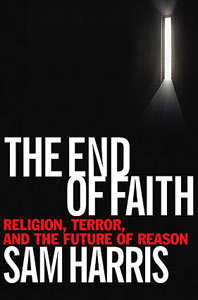
In his book The End of Faith, Harris wrote: “Some beliefs are so dangerous that it may be ethical to kill people for believing them”. Harris was criticized by Christian apologist Victor Reppert and others for his promotion of the idea that killing people for thought crimes is morally acceptable.

In 2022, Sam Harris said, "Hunter Biden could have had the corpses of children in his basement - I would not have cared." In response, Theodore Beale wrote: "Atheists have no moral anchor. There’s literally nothing there. Their much-vaunted, self-constructed value systems revolve around nothing more than whatever happens to trigger their emotions at any given moment. They are simple creatures of pure appetite and rhetoric. Remember, Sam Harris is supposed to be among the finest, smartest, most highly-refined philosophers that the atheist community has on offer."

The comedian and social commentator Jimmy Dore, who indicates that Sam Harris is an immoral, narcissist, says that he helped cause Harris to angrily quit Twitter in a fit of rage. Since Harris' anti free speech comments and his immoral, political tribalism, a lot of people have lost respect for Harris and called him out on his ill-behavior. Harris blocked them on Twitter before quitting the platform.

Dore also indicated that Harris recently lost a number of debates and now refuses to debate various people.


Friday, March 31, 2023

Benjamin Hoadly and the Bangorian Controversy on This Day in History


Benjamin Hoadly

This Day in History: The Bangorian Controversy started on this day in 1717. The Bangorian Controversy was a theological argument within the Church of England in the early 18th century, with strong political overtones. The origins of the controversy lay in the 1716 posthumous publication of George Hickes's Constitution of the Catholic Church, and the Nature and Consequences of Schism. In it, Hickes, as Bishop of Thetford, on behalf of the minority non-juror faction that had broken away from the Church of England after the Glorious Revolution, excommunicated all but the non-juror churchmen. Benjamin Hoadly, the Bishop of Bangor, wrote a reply, Preservative against the Principles and Practices of Non-Jurors; his own Erastian position was sincerely proposed as the only test of truth.

The controversy itself began very visibly and vocally when Hoadly delivered a sermon on 31 March 1717 to George I of Great Britain on The Nature of the Kingdom of Christ. His text was John 18:36, "My kingdom is not of this world" and from that, Hoadly deduced, supposedly at the request of the king himself, that there is no Biblical justification for any church government of any sort. He identified the church with the Kingdom of Heaven. It was therefore not of this world, and Christ had not delegated His authority to any representatives.

"Hoadly, in a sermon preached on March 31 1717, put forward the view that the church was not justified in having any form of government as it was concerned with matters not of this world. Sincerity of belief rather than any church structure was what mattered." Source

The reading of this one Scripture at John 18:36 became an act of civil disobedience and questioned the authority, not only of the Church, but the divine right of kings.