Showing posts with label martyr. Show all posts

Thursday, February 23, 2023

Polycarp on this Day in History

This Day in History: February 23 is recognized as a feast day in honor of Polycarp of Smyrna. 

Polycarp was a Christian bishop/overseer of Smyrna. According to the Martyrdom of Polycarp, he died a martyr, bound and burned at the stake, then stabbed when the fire failed to consume his body. Polycarp is regarded as a saint and Church Father in the Catholic, Eastern Orthodox, Oriental Orthodox, Anglican, and Lutheran churches.

Both Irenaeus and Tertullian say that Polycarp had been a disciple of John the Apostle, one of Jesus' disciples. In On Illustrious Men, Jerome writes that Polycarp was a disciple of John the Apostle and that John had ordained him as a bishop of Smyrna. Polycarp is regarded as one of three chief Apostolic Fathers, along with Clement of Rome and Ignatius of Antioch.

The webpage at https://carm.org/early-trinitarian-quotes has a few quotes where they are trying to show that the early Church Fathers believed in the Trinity Doctrine. They start off with Polycarp:

"O Lord God almighty . . . I bless you and glorify you through the eternal and heavenly high priest Jesus Christ, your beloved Son, through whom be glory to you, with Him and the Holy Spirit, both now and forever" (n. 14, ed. Funk; PG 5.1040).

I noticed the same quotes with the same ellipsis (...) in Russell Sharrock's book, The Triunity of God (page 111); and in Matthew A. Paulson's book Breaking the Mormon Code, under the heading "Early Christian Quotations Suggesting the Trinity" and attributing the quote to Polycarp's Letter to the Philippians.

So what is missing in the ellipsis (...)? The words that are missing are "the Father of your beloved Son, Jesus Christ." So, the "Lord God almighty" is, according this quotation, the Father. The title "Lord God almighty" was not attributed to the Son or the Holy Spirit.

Also, this quote is not from Polycarp's Letter to the Philippians, but rather the Martyrdom of Polycarp, and this piece of work has been recognized as a literary forgery. See https://tinyurl.com/Polycarp-Forgery

Alvan Lamson, when examining the Epistle Of Polycarp came to the conclusion "that this old martyr had no conception of Jesus Christ as equal with God, or as one with him except in will and purpose. Here are no metaphysics, no confusion or obscurity, no hair-splitting distinctions. The Father is separated from the Son by a broad and distinct line, one as supreme, the other as subordinate; one as giving, the other as receiving; the Father granting to the Son a "throne at his right hand."


This book, "The Impersonality of the Holy Spirit by John Marsom" is available on Amazon for only 99 cents. See a local listing for it here; Buy The Absurdity of the Trinity on Amazon for only 99 cents by clicking here - see a local listing for this here

Thursday, February 17, 2022

Martyred Heretic Giordano Bruno on This Day in History


This Day in History: Giordano Bruno was burned at the stake on this day in 1600 for the crime of heresy. His crimes were believing in the heliocentric system of the universe, but also for his denial of eternal damnation, the Trinity, the divinity of Christ, the virginity of Mary, and transubstantiation. Hegel wrote that Bruno's life represented "a bold rejection of all Catholic beliefs resting on mere authority."


All of Bruno's works were placed on the Index Librorum Prohibitorum ("List of Prohibited Books") in 1603. The inquisition cardinals who judged Giordano Bruno were Cardinal Bellarmino (Bellarmine), Cardinal Madruzzo (Madruzzi), Camillo Cardinal Borghese (later Pope Paul V), Domenico Cardinal Pinelli, Pompeio Cardinal Arrigoni, Cardinal Sfondrati, Pedro Cardinal De Deza Manuel and Cardinal Santorio (Archbishop of Santa Severina, Cardinal-Bishop of Palestrina).

The measures taken to prevent Bruno continuing to speak have resulted in his becoming a symbol for free thought and free speech in present-day Rome, where an annual memorial service takes place close to the spot where he was executed.

The Vatican has published few official statements about Bruno's trial and execution. In 1942, Cardinal Giovanni Mercati, who discovered a number of lost documents relating to Bruno's trial, stated that the Church was perfectly justified in condemning him. On the 400th anniversary of Bruno's death, in 2000, Cardinal Angelo Sodano declared Bruno's death to be a "sad episode" but, despite his regret, he defended Bruno's prosecutors, maintaining that the Inquisitors "had the desire to serve freedom and promote the common good and did everything possible to save his life". In the same year, Pope John Paul II made a general apology for "the use of violence that some have committed in the service of truth".

As to his rejection of the Trinity:

"Unitarians do not find in the Bible or in reason any warrant for accepting the doctrine of the Trinity; they believe that Jesus represented himself as being, not God the Son, but the son of God, our brother, the reconciler of man to God, not of God to man. They believe that history makes it clear that the early Christian church was not Trinitarian, but Unitarian, and that the doctrines of the deity of Christ and of the Trinity came into Christianity only by degrees, and as corruptions from outside,- never being accepted by the church in any authoritative way until the council of Nicea in the year 325. They also believe that in this manner the doctrines of vicarious or substitutional atonement, total depravity, the infallibility of the Bible, etc., came in from without as corruptions of the Christian stream, and at points that are easily traced. Hence a leading aim of Unitarianism in all its later history has been to get back to the simplicity and purity of the teachings of Christ.

In the great controversy that culminated at Nicea, Athanasius was the leader of the Trinitarian party, and Arms of the Unitarian. The decision was long doubtful, but was finally turned by the Emperor Constantine in favor of the Trinitarians. Trinitarianism being thus adopted as the state religion, Unitarianism began to decline; and after the rise of the Roman Catholic church was gradually crushed out. However, Ulfilas, the eminent missionary to the Goths in the fourth century, was a Unitarian, and the Gothic nations continued to hold Christianity in its Unitarian form for several centuries.

With the revival of letters, and especially with the appearance of the Protestant Reformation in the fifteenth and sixteenth centuries, Unitarianism reappeared and came somewhat prominently to the front. Many noted scholars, writers, preachers, and martyrs of those times were Unitarians; among them being Servetus, Lelius and Faustas Socinus, Bernardino Ochino, Blandrata, and Francis David. The celebrated Giordano Bruno, though not calling himself a Unitarian, was in the exact line of Unitarian thought. As the Roman Catholics persecuted the Protestants, so both Catholics and Protestants combined to persecute the Unitarians." The Unitarian, 1890

See also The Terrible Death of Michael Servetus
https://newworldtranslation.blogspot.com/2019/10/the-terrible-death-of-michael-servetus.html

Unitarian History by John Hayward 1860
https://newworldtranslation.blogspot.com/2019/03/unitarian-history-by-by-john-hayward.html

Johann Sylvan - Unitarian Martyr
https://newworldtranslation.blogspot.com/2018/12/johann-sylvan-unitarian-martyr.html

The Trinity NO PART of Primitive Christianity, by James Forrest A.M. 1836
https://newworldtranslation.blogspot.com/2019/03/the-trinity-no-part-of-primitive.html

The Interrogation of Unitarian Anabaptist Martyr Herman van Vlekwijk
https://newworldtranslation.blogspot.com/2018/10/the-interrogation-of-unitarian.html

Peter Gunther, Unitarian Martyr
https://newworldtranslation.blogspot.com/2018/09/peter-gunther-unitarian-martyr.html

A Catholic Priest Declares the Trinity Doctrine "Opposed to Human Reason."
https://newworldtranslation.blogspot.com/2018/07/a-catholic-priest-declares-trinity.html

Edward Wightman (Unitarian Martyr)
https://newworldtranslation.blogspot.com/2018/07/edward-wightman-unitarian-martyr.html


Friday, December 31, 2021

Bible Translator John Wycliffe on This Day in History


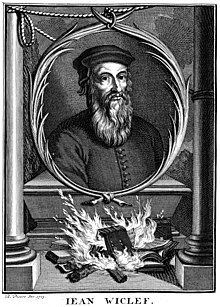
Wycliffe and the burning of his books

This day in history: English scholastic philosopher, theologian, biblical translator, reformer and priest John Wycliffe died on this day in 1384. He became an influential dissident within the Roman Catholic priesthood during the 14th century and is considered an important predecessor to Protestantism. Wycliffe questioned the privileged status of the clergy which had bolstered their powerful role in England and the luxury and pomp of local parishes and their ceremonies.

Wycliffe is however best known for his Bible translation. "The first complete translation of the Bible into our language was made about the year 1380 by John de Wycliffe, or Wickliffe. There are several manuscript copies of it in the Bodleian and other European libraries. This great work unlocked the Scriptures to the multitude, or, as one of his antagonists, bewailing such an enterprise, worded it, 'the gospel pearl was cast abroad and trodden under foot.'" Source

The Church at the time did not like this development. Fines were handed out for anyone reading Wycliffe's Bible. Some of Wycliffe's supporters were burned at the stake. 

Bible translations were also a threat to Church authorities as it made people question church doctrines:

"Wyclif's manuscript translations of the Bible had been widely circulated from about 1380 on, and it is said that some of his followers were tinged with Antitrinitarianism; but this Bible had to be read in secret, as did Tyndale's first printed New Testament of 1525, for fear of the law. In 1535, however, the English Bible began to be accessible to all, and many were reading it for the first time. First and last the influence of this book, when read in comparison with the creeds, has underlain all others leading men to reject the doctrine of the Trinity. Some of the most notable of the early English Unitarians declared they had never read nor heard the Unitarian doctrine, but had come to it solely through reading their Bibles."~Earl Morse Wilbur

The Council of Constance declared Wycliffe a heretic on 4 May 1415, and banned his writings, effectively excommunicating him retroactively. The Council decreed that Wycliffe's works should be burned and his bodily remains removed from consecrated ground. This order, confirmed by Pope Martin V, was carried out in 1428. Wycliffe's corpse was exhumed and burned and the ashes cast into the River Swift, which flows through Lutterworth.

See also Rare Olde English Bibles on DVDrom (Tyndale, Matthews, Coverdale, AV1611)